
Projects
This page provides an overview of current and completed projects relating to the NwT degree program at KIT and is constantly being updated.
A large number of projects are presented, which serve the further development and visualization of the NwT course. Furthermore, you will find projects that are also relevant in a school context.
UNaTec
UNaTec project

The subject of the project is education for sustainable development (ESD) in the context of NwT at grammar schools in Baden-Württemberg. The project is linked to teacher training and further training as well as the promotion of pupils' interests in the subject of sustainable product development using bionic methods in the field of technical mechanics. The aims of the project are to illustrate the content and process-related competencies provided for in the educational standards for STEM lessons by means of models and methods developed for biomechanics using evaluated teaching and learning materials and to convey them in a didactically accessible way in order to achieve positive effects with regard to the perceived quality characteristics of the lessons, the development of interest and motivation and the professional orientation of pupils in STEM lessons. The aim is to use the concepts and models developed beyond the subject of STEM in other science and technology subjects (e.g. physics, biology, technology) and other school types. Furthermore, technical literacy acquired in a suitable context and taking ecological aspects into account should lead in the long term to a future-oriented ability to discuss and make decisions as well as a well-founded evaluation competence with regard to the quality of products and promote an associated change in behavior as a consumer.
digiLAB
digiLAB project
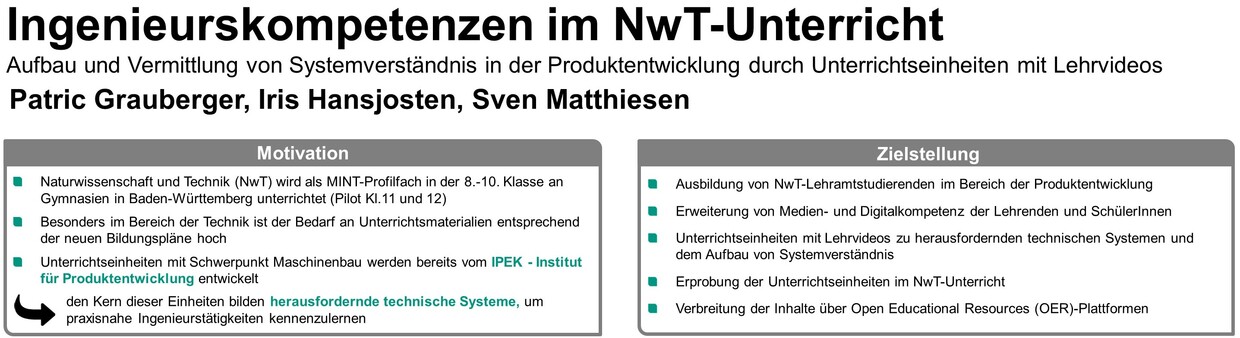
The Ministry of Science, Research and the Arts (MWK) is funding the joint project "digiLAB - digitalized learning in teacher training" in which the IPEK - Institute for Product Development is working together with the Centre for Teacher Training (ZLB). In this project, the IPEK prepares student teachers in a "learning through teaching" context for their task of introducing pupils to STEM subjects in a contemporary and media-competent way.
The digitalization of teaching units is a challenge in "young" subjects such as science and technology (STEM). There is little established teaching content and much of the technical knowledge quickly becomes outdated. Nevertheless, technology-related subjects such as NwT, which in Baden-Württemberg imparts a general technical education and an interest in careers in engineering, offer the potential to teach digital and media education skills in a scientific context.
As a solution approach, teaching units are being developed in which the development of technical system understanding is taught using digital tools and associated rapid prototyping processes. The developed teaching units are implemented and evaluated in different environments with nine experts and 51 students. The qualitative evaluation shows that the didactic reduction of everyday product development tasks supports students' technical understanding. Data from the digital tools used is also available to assess the knowledge imparted and to continuously develop digital-based learning contexts.
Further information on digiLAB at the Institute for Product Development (IPEK).
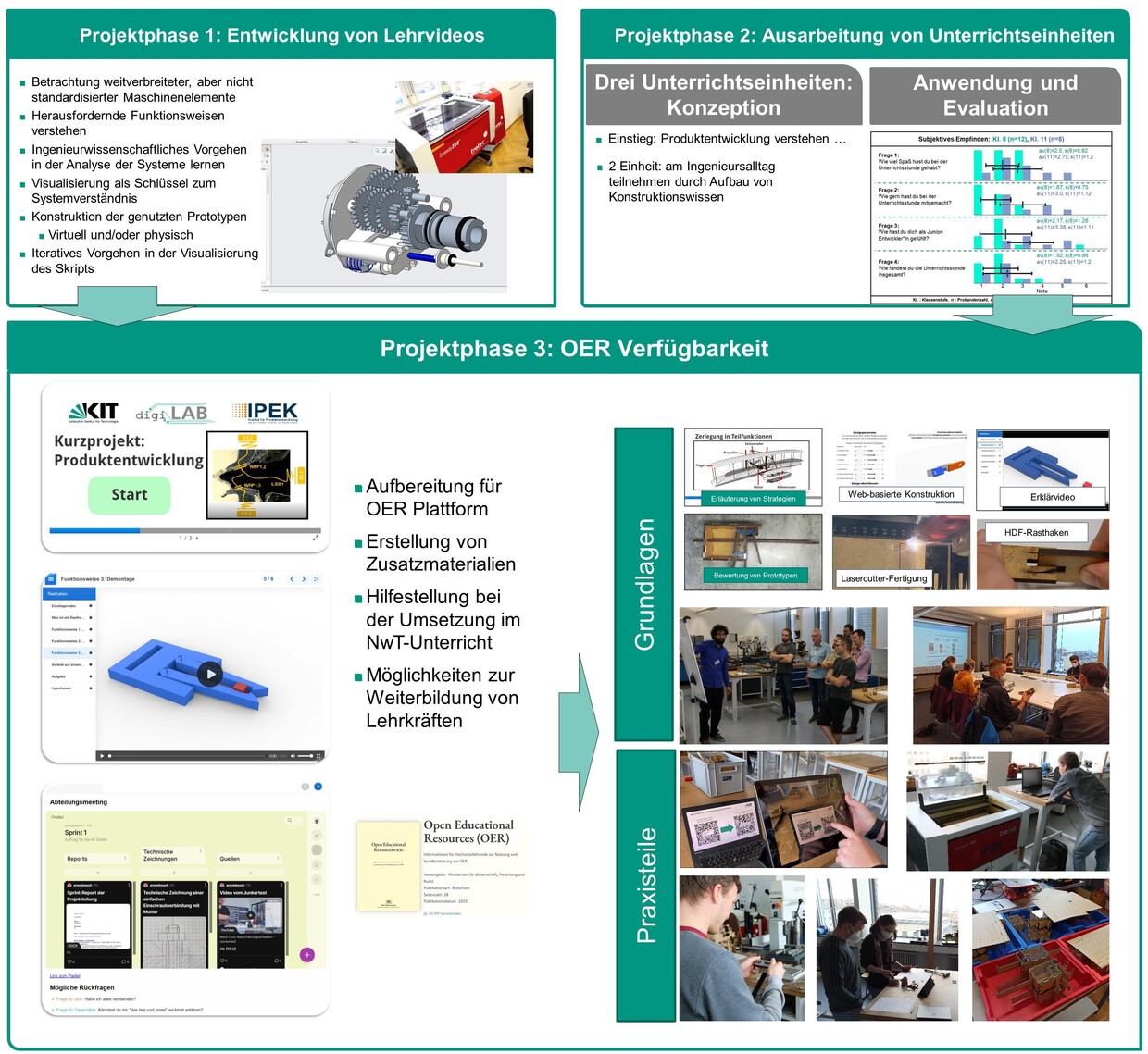
The teaching and learning materials created as Open Educational Resources (OER) as part of this project can be viewed and downloaded here:
- Learning unit ratchet hook (download via ZOERR - Central Open Educational Resources Repository)
- Learning unit wedge lock washer/professional profile product development engineer (Download via ZOERR - Central Open Educational Resources Repository)
- Cartridge press learning unit (Download via ZOERR - Central Open Educational Resources Repository)
Experience and teaching technology
Experience and teaching technology
Prof. Matthiesen, Institute for Product Development (IPEK) at KIT - Here is an insight into the module “Experiencing and teaching technology”, which was developed for NwT students, and the possibilities offered by the NwT teaching-learning concept.
More information on the teaching-learning concept can be found on the IPEK website.

Internally funded projects: Innovation Fund NwT
The NwT Innovation Fund is intended to sustainably increase the visibility of NwT teaching degree program both internally and externally at KIT and thus also contribute to attracting more students to the engineering sciences in the long term, as well-trained NwT teachers are important multipliers in schools. A maximum of €35,000 can be applied for per project for a maximum of three years, according to a multi-stage plan, so that after one year the progress is presented to the NwT Study Commission, which then decides whether to approve further project funding.
The projects funded as part of the NwT Innovation Fund are presented below.
Your own ideas and applications for the NwT Innovation Fund should be submitted to the NwT Study Commission. If you have any questions, please do not hesitate to contact the course coordinator.
Drive technology student project
APL student project: Drive technology
The drive technology student project aims to appeal to young people interested in technology and get them excited about the world of current and future mobility based on miniaturized drives. As part of the project, two model sets of an H2-Hybrid model vehicle were purchased, which can be tested on a roller test bench by students and pupils in the future.
The project is being implemented by APL Automobil-Prüftechnik Landau GmbH/Institute for Piston Engines KIT 2022. In the future, model vehicles developed with different drive systems will be tested against each other as part of a KIT competition.

Merchandise & Marketing NwT
Merchandise & Marketing NwT
During practical phases in schools, NwT students repeatedly experience that many people in the school system are still unaware that NwT is a subject in its own right. They would like to make a contribution to increasing the visibility and awareness of the subject in schools and thus to increasing the number of NwT students. The following measures are planned:
1) Creation of an NwT collection, such as T-shirts, polo shirts, sweaters, which can be purchased by NwT students and worn in school practice phases, traineeships, everyday working life and leisure time;
2) Creation and purchase of merchandise products, such as ballpoint pens etc., which can be distributed in schools and at study and career information events. This should be done with the involvement of NwT students and in cooperation with the NwT course coordinator.

Digital twin - automation technology
Digital twin - automation technology
The aim of the project is to make automation technology understandable for students by developing mobile mixed reality robotics. The system consists of a real robot arm and a virtual twin that are linked via a virtual environment. A physical environment can thus be simulated in a video game context. The digital twin can interact with simulated objects and influence the virtual reality. The low-threshold access to this system should make it possible for pupils, students and teachers without prior knowledge to program robot systems remotely and optimize processes, thus providing an insight and introduction to the world of robotics.
Development of digital offers for students
Development of digital offers for students
An initial goal of the project is to bundle digital offerings related to NwT for students and make them visible on a platform. As part of the Mechatronics Learning and Application Center (LAZ), which is currently under construction, a 3D environment is to be created as a digital twin in addition to a real production environment (funded by the state of Baden-Württemberg), which students and pupils will be able to access via a browser. Offers for pupils are to be integrated into this environment and developed specifically for this purpose, so that digital content can also be linked to physical products.