
Structure & content of the NwT teaching degree program
Teacher training comprises several phases: The first phase consists of university studies leading to a Bachelor's and Master's degree in Education (B.Ed. and M.Ed.). Successful completion of the Bachelor's and Master's degrees is a requirement for entering the second phase, the traineeship or preparatory service.
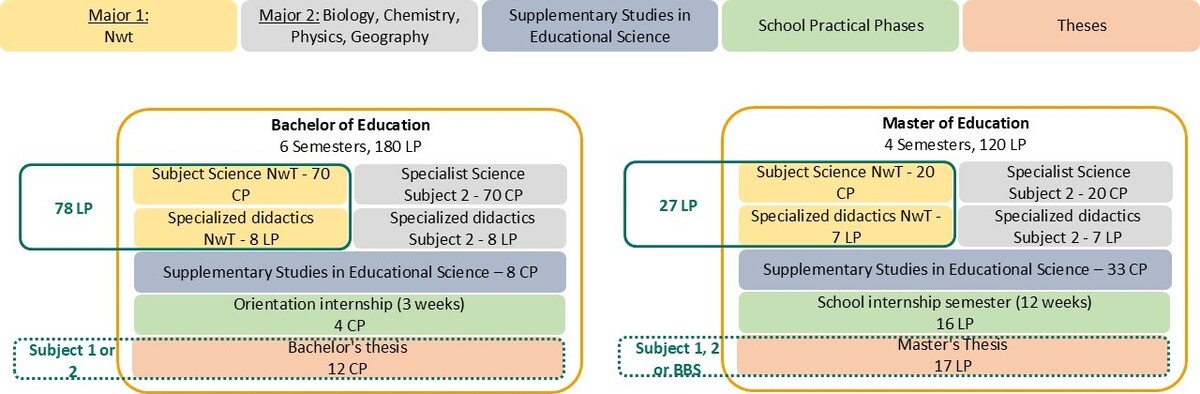
The NwT teaching degree consists of the Bachelor's degree (6 semesters) and the Master's degree (4 semesters). Please refer to the module handbooks to find out how the proportions of technical and scientific content and subject didactics are divided between the Bachelor's and Master's degree courses. The Bachelor's and Master's degree programs consist of the following components:
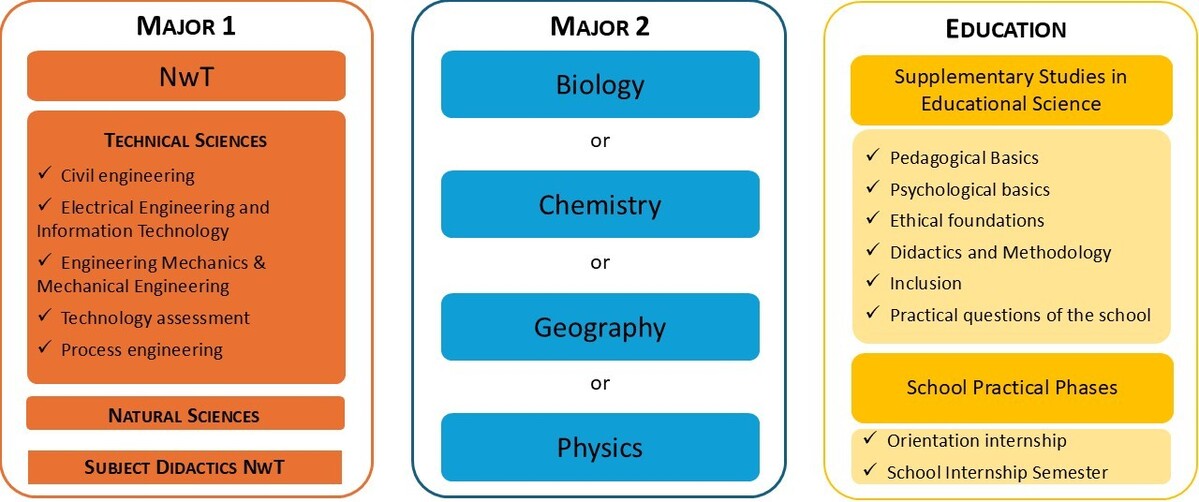
- Subject-specific and didactic content of both subjects
- The accompanying studies in educational science
- School practice phases (orientation internship and school practice semester)
- Final theses (Bachelor's and Master's thesis)
The scope of the respective content is specified in credit points (CP). 1 CP corresponds to a workload of approx. 30 hours. In the Bachelor's degree course, the focus is on subject-specific training, whereas in the Master's degree course, the proportion of accompanying studies in educational science and school practice for the acquisition of pedagogical and practical school skills is proportionately higher. In both the Bachelor's and Master's degree programs, didactic courses combine subject-specific science and didactics and are specifically designed to meet the requirements of NwT teaching.
The Bachelor's degree program NwT
Contents of the Bachelor's degree program NwT
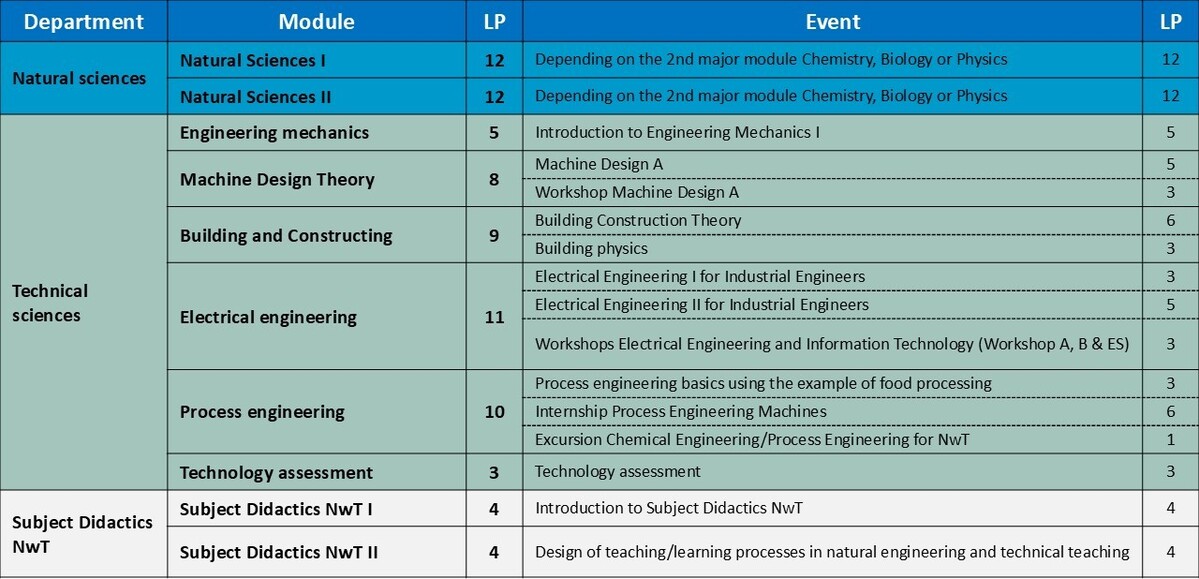
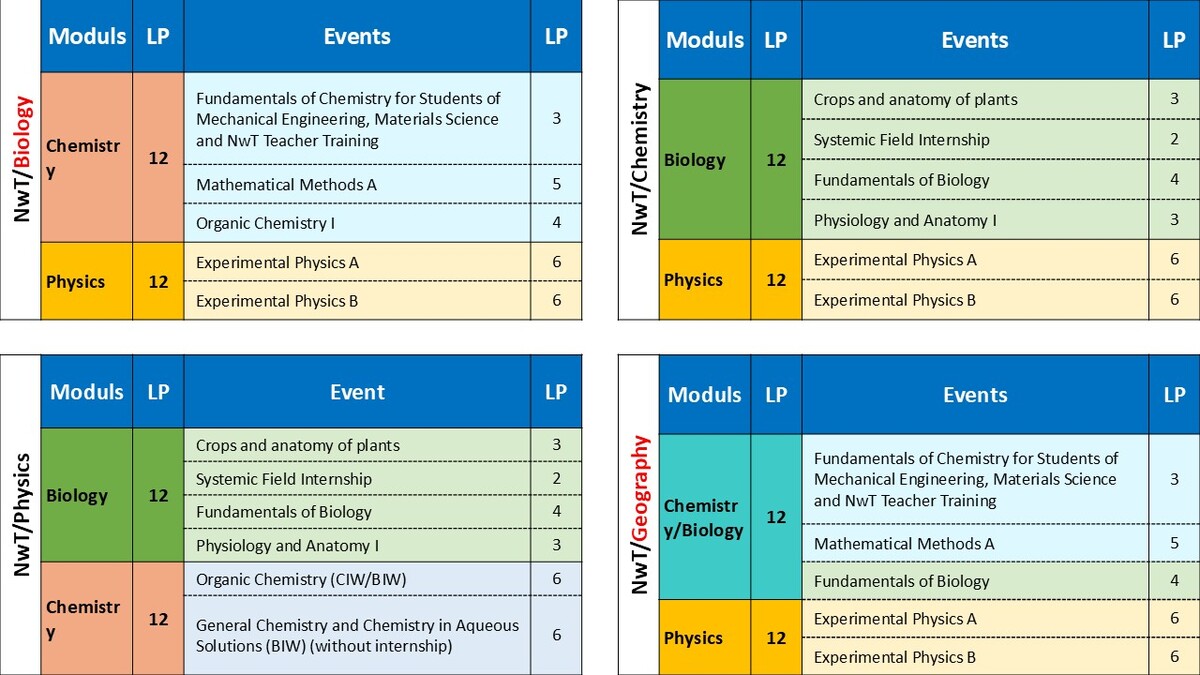
The Bachelor's degree program is mandatory and teaches the basics of natural sciences (biology, chemistry, physics) and mathematics as well as the basics of engineering (civil engineering, electrical engineering, mechanical engineering and process engineering).
The scientific basics (1st-4th semester) include classical experimental physics as well as inorganic and organic chemistry and the basics of biology. The courses to be attended depend on the chosen second main subject. The orientation examinations must be taken in the second part of the course (physics, biology, chemistry or geography) in the first or second semester.
The fundamentals of technology (2nd-6th semester) include subjects such as technical mechanics I, machine design theory I and II, building design theory and building physics, electrical engineering, process engineering fundamentals using the example of food processing and technology assessment.
Specialist didactic courses are part of the NwT course from the start and can be attended in the second semester, for example.
Detailed information on modules and courses can be found in the module handbooks can be found in the module handbooks. The sample study plan provides an overview of a possible structure of the NwT degree program. If you have any questions, the NwT course coordinator will be happy to help.
The Master's degree program NwT
Content of the Master's degree program NwT
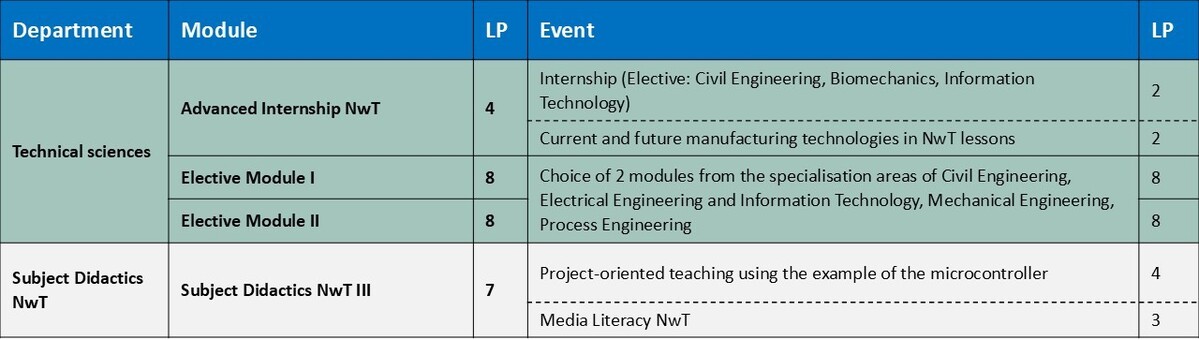
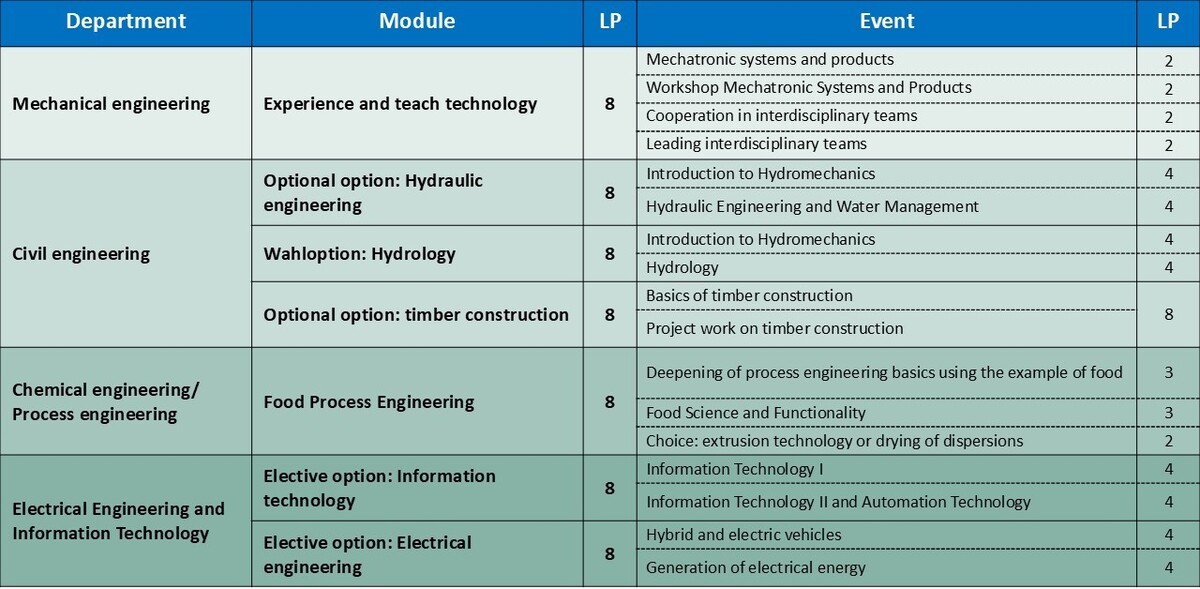
In addition to subject didactics, the Master's degree program in NwT primarily offers the opportunity for individual specialization in the mandatory elective area. This involves choosing two modules, each worth 8 CP, from different areas of specialization. On the left, you can see which mandatory elective modules are offered in which areas of specialization.
Detailed information on modules and courses can be found in the module handbooks. If you have any questions, the NwT program coordinator will be happy to help.
The Master's degree program in NwT as an extension subject
M.Ed. extension subject NwT
The study of NwT as a third subject in the so-called Extension Master's degree (M.Ed. Extension Subject) consists of all subject-related and subject-didactic modules of the regular Bachelor's and Master's degree program NwT (see overviews B.Ed. and M.Ed.). Detailed information on modules and courses can be found in the module handbooks can be found in the module handbooks.
The study schedule should be adapted individually and can vary greatly depending on whether the extension subject is started during the regular Bachelor's/Master's degree program or only afterwards. The NwT program coordinator will be happy to help!
Scholarships for STEM teacher training students
Germany Scholarship
What is the Deutschlandstipendium? The Deutschlandstipendium at KIT includes a grant of €300 per month for a period of one year.
The scholarship is paid independently of income and parents and does not count towards BAföG. Half of the scholarships are financed by private sponsors (companies, private individuals, foundations and associations) and the other half by the federal government.
Who can apply? Students and first-year students of all nationalities who are already enrolled at KIT or are starting their studies at KIT can apply. The Deutschlandstipendium scholarship supports students whose previous academic achievements are expected to be outstanding. In addition to special successes at school and/or university, the funding criteria also include social commitment, for example in associations or in university politics, in church or political organizations as well as commitment in the social environment, in the family or in a social institution. The overcoming of particular biographical hurdles resulting from family or cultural background is also taken into account.
Further information on the call for applications at KIT and the Deutschlandstipendium.
Scholarships for student teachers
Here you can find more scholarships for student teachers.